News and Insights
Follow the latest news from MUS Group and its project developments and partnerships, along with articles and specialized insights on investment, real estate development, project management, and construction.
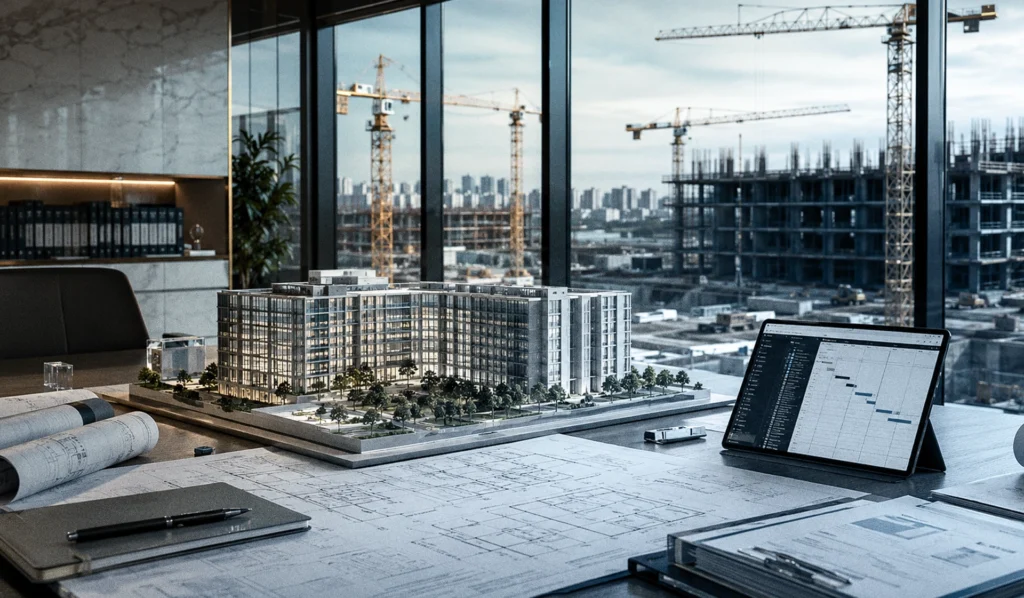
How Are Large Projects Managed Efficiently?
Large projects begin long before equipment arrives on site. The real first stage is building a clear vision for the project, understanding its objectives, operational requirements, budget, timeline, and potential risks. The more precise this stage is, the more efficient execution becomes later on, and the less likely it is to suffer delays or unexpected costs.
On large projects, a good design or a strong contractor is not enough on its own; all of the project’s elements must work within a single system. This is where professional project management becomes essential, linking the owner, the consultant, the contractors, the suppliers, and the regulatory authorities, and ensuring that all parties move according to a unified plan and defined objectives.
Effective management begins with defining the scope of work precisely, then developing a realistic schedule that outlines the design, procurement, execution, inspection, and handover phases. In parallel, a clear plan for resources and costs is prepared, and responsibilities and decision-making pathways are defined, preventing task conflicts and delays in approvals.
During execution, project management becomes a process of continuous monitoring. Progress is measured against the plan, quality is reviewed, field challenges are addressed, and any changes that may arise on the project are managed. Risk management also plays a key role in anticipating problems before they occur, whether they relate to procurement, the timeline, contracts, or operational conditions.
The final stage, however, is not limited to completing the construction work. It includes testing, acceptance, closing out outstanding observations, handing over documentation, and confirming that the facility is ready for actual operation.
At MUS Group, we view project management as an integrated process aimed at protecting the value of the investment and achieving a balance between quality, cost, time, and performance. The true success of any project is measured not only by the final appearance of the building, but by its ability to fulfill the purpose for which it was created, efficiently and sustainably.
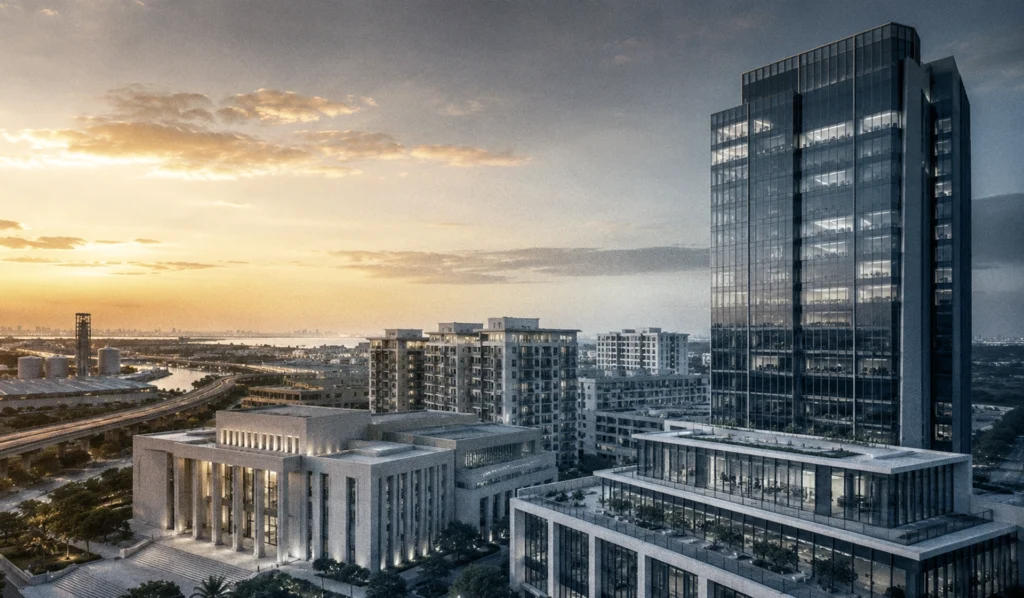
Experience That Accumulates, Achievement That Evolves
Experience in the construction sector is not measured by the number of years alone, but by the diversity of challenges, projects, and markets encountered over those years. Each project adds new knowledge, and each sector imposes different requirements. Over time, this builds a body of experience that makes decisions more precise and better equipped to handle complex projects.
Since 1985, the journey of MUS Group has been associated with projects across multiple sectors, ranging from construction and residential complexes to infrastructure, transportation, government facilities, industrial projects, hotels, and commercial towers.
This diversity creates a significant advantage in project management. The challenges that arise in an industrial project differ from the requirements of a hotel facility, and the working environment of a transportation project is entirely different from that of a residential complex development. Nevertheless, there are shared principles that remain constant: planning, quality, time management, cost control, and coordination among all parties.
Working across different markets adds another dimension to experience. Each market has its own regulatory systems, operational character, and work culture. As a result, the ability to adapt becomes an essential part of the success of any organization operating regionally.
Major projects also teach organizations the importance of building strong internal systems rather than relying on individual decisions. Modern project management has therefore increasingly relied on clear procedures for monitoring performance, managing contracts, overseeing quality control, handling risks, and managing change.
Over time, accumulated experience becomes a tool for decision-making. A problem that appears new in one project may resemble a challenge previously addressed in another, allowing faster and more realistic solutions to be reached.
For MUS Group, the experience built over decades forms the foundation for the next phase of the Group’s business. The past represents not only a record of completed projects, but also cumulative knowledge that is applied to developing more efficient projects, building stronger partnerships, and pursuing more ambitious investment and execution opportunities in the future.

Real Estate Development: From Opportunity to Value
Real estate development does not begin with buying land or drawing plans. It begins with an investment decision built on a clear understanding of the market, the opportunity, and the real need. A successful real estate project is the result of a series of well-considered decisions that start before design and extend through operation and long-term investment.
In the early stages, the site and its surroundings, the expected nature of demand, and the most suitable use for the project are analyzed. The site may be suitable for a residential compound, an office tower, a hospitality project, or a mixed-use development, but identifying the right option requires a careful reading of the technical and economic feasibility.
Once the vision is defined, the development of the real estate product itself begins. This is where the idea is turned into a project that can be built, marketed, and operated efficiently. It includes studying the spaces, the distribution of functions, the quality of the experience, the architectural identity, the cost of construction, and future maintenance and operating requirements.
One common mistake in some projects is focusing on architectural form without sufficient study of operational or investment aspects. A building may be visually appealing, but if it does not achieve the required efficiency in use or operation, it may lose a significant part of its economic value.
Modern real estate development therefore relies on integrating the engineering, financial, and commercial dimensions. Decisions are evaluated based on their impact on the project as a whole, not only on the construction phase. The choice of materials, facade types, parking design, shared services, energy systems, and even the distribution of spaces are all elements that directly affect the final value of the project.
Risk management also plays an important role in real estate development, especially in large projects that span several years and are affected by market conditions, costs, financing, and regulatory systems.
MUS Group adopts a real estate development vision built on delivering sustainable value for the owner, the investor, and the end user. The goal is not merely to construct a new building, but to develop a real asset capable of preserving its value and fulfilling its economic and operational role over the long term.